

Imagine this: You’re walking into a coffee shop you’ve never visited before. The smell of roasted beans hits you, the hum of the espresso machine fills the air, and suddenly, a wave of certainty washes over you. You know exactly where the barista will turn, you know the customer at the counter will order a latte, and you know you’ll trip slightly on the rug. It feels like a memory, vivid and sharp, yet you know logically you’ve never been here. You are experiencing déjà vu—the French term for “already seen.”
It’s a sensation that feels like a glitch in the matrix, a moment where the present slips into the past. Have you ever wondered if you’re living a second life? Or perhaps, is your brain just trying to save a little processing power?
Welcome to The Hidden Thread, where we pull back the curtain on the strange patterns woven into our world. Today, we’re diving into the eerie, fascinating, and surprisingly common phenomenon of déjà vu. We aren’t looking for ghosts or time travelers; instead, we’re looking for the hidden patterns in our own biology that make us feel like we’ve lived this moment before.
The Great Glitch in the Matrix
Let’s start with the feeling itself. That sudden jolt of familiarity is universal. Studies suggest that about two-thirds of us have experienced it at least once. It’s not just a random quirk; it follows a pattern. It tends to happen more often to younger people, usually peaking in our late teens and early twenties, and then slowly fading as we age.
But why? Is it a message from the universe? A sign of a parallel dimension? While those ideas are fun to dream about, the pattern we’re finding here is much closer to home. It’s happening right inside your head.
According to the Cleveland Clinic, déjà vu is a feeling that you have lived through a situation that is currently happening, even though you know you haven’t [https://health.clevelandclinic.org/deja-vu-what-it-is-and-when-it-may-be-cause-for-concern]. It’s a disconnect between what you know is true and what you feel is real. It’s like your brain is playing a prank on your senses, sending a signal that says, “I’ve got this!” when you actually don’t.

Photo by Monstera Production
The Brain’s Two-Track System
To understand this mystery, we have to look at how our brains process memories. Imagine your brain is a busy library. Usually, when you experience something new, it gets filed away in the “New Arrivals” section. But sometimes, for a split second, the librarian makes a mistake. They accidentally stamp a brand-new book with a date from ten years ago. Suddenly, the new book looks like an old favorite.
This is the core of the pattern scientists are seeing. Our brains have two main systems for handling information: the sensory input (what you see and hear right now) and the memory retrieval (what you remember from the past). Normally, these run on separate tracks. But in déjà vu, it seems like the tracks cross.
According to Dr. Akira O’Connor (BBC Science Focus), “Déjà vu is a feeling of familiarity without recollection” [https://www.sciencefocus.com/the-human-body/deja-vu]. This means you feel like you know something, but you can’t remember why. You can’t point to a specific memory of the coffee shop because it hasn’t happened yet. The feeling is there, but the story is missing.
This suggests that the brain is generating a sense of familiarity independently of actual memory. It’s a false positive—a signal that says “known” when the answer is “unknown.”
The Neural Short Circuit
So, what causes this short circuit? Researchers have proposed a few theories, and they all point to a fascinating pattern of electrical activity in the brain. One leading theory involves the hippocampus, the part of the brain responsible for forming new memories.
Think of the hippocampus as the brain’s filing clerk. Sometimes, this clerk gets a little too eager. Instead of waiting for the full experience to finish before filing it, the clerk might file a partial experience as a completed memory.
According to a study published in the journal Consciousness and Cognition, researchers found that déjà vu might be caused by a spontaneous discharge of neurons in the rhinal cortex, which is involved in memory and familiarity [https://pmc.ncbi.nlm.nih.gov/articles/PMC3842028/]. This tiny electrical spark tricks the brain into thinking the current moment is a memory.
It’s like a light switch that flickers on and off too quickly. The light (the feeling of familiarity) turns on, but the bulb (the actual memory) isn’t connected. The result is a flash of recognition that vanishes as soon as you try to grasp it.
Another theory suggests that it’s a problem with “dual processing.” This means the brain receives the same information twice, but with a tiny delay. The first time, the information goes straight to the memory center. The second time, it goes to the perception center. Because the second signal arrives a fraction of a second later, the brain interprets it as a memory of the first signal.
According to the American Psychological Association, this dual-processing error could explain why the feeling is so strong yet so fleeting [https://www.apa.org/news/podcasts/speaking-of-psychology/deja-vu]. The brain is essentially arguing with itself, creating a loop of confusion that feels like a memory.
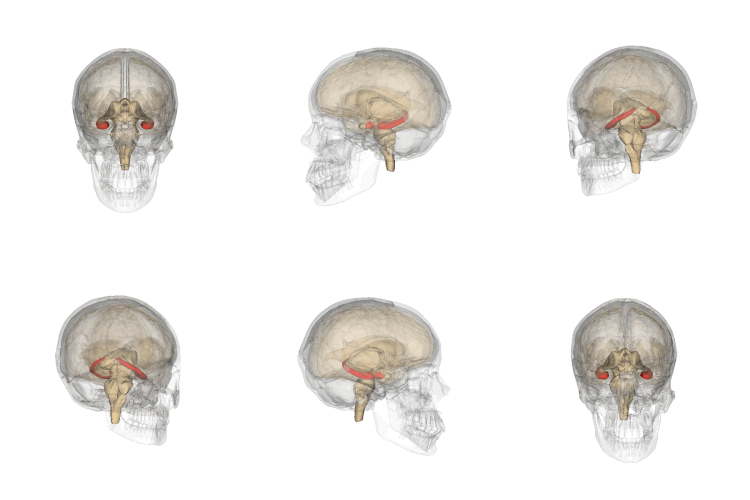
Images are generated by Life Science Databases(LSDB)., CC BY-SA 2.1 JP, via Wikimedia Commons
Who Gets the Glitch?
Not everyone experiences déjà vu with the same frequency. There’s a pattern here, too. Younger people seem to get it more often. As we get older, the frequency tends to drop. Why?
One possibility is that our brains become more efficient at filtering out noise as we age. Or perhaps, the neural pathways that cause these glitches change over time.
According to Psychology Today, people who travel frequently or have a rich imagination might experience déjà vu more often [https://www.psychologytoday.com/us/blog/brain-babble/201510/why-do-some-people-get-d-j-vu-more-often-others]. This makes sense if you think about it. If your brain is constantly processing new environments and creating new associations, it might be more prone to mixing things up.
There’s also a link to stress and fatigue. When you’re tired or stressed, your brain’s ability to process information accurately can slip. This might explain why you’re more likely to feel déjà vu after a long day at work or during a period of high anxiety.
According to Healthline, “Stress and fatigue can trigger déjà vu episodes” [https://www.healthline.com/health/mental-health/what-causes-deja-vu#takeaway]. It’s a reminder that our mental state plays a huge role in how we perceive reality. When the mind is tired, the lines between past and present can blur.
| Characteristics | Description |
|---|---|
| Duration | Usually lasts just seconds (6–10 seconds typically) |
| Frequency | About 60–80% of people experience it at least once |
| Peak Age | Most common in people aged 15–25 |
| Triggers | Fatigue, stress, travel, or sometimes nothing obvious |
When the Pattern Breaks: A Warning Sign
Most of the time, déjà vu is harmless. It’s just a quirky glitch, a moment of confusion that passes in seconds. But there are times when the pattern changes, and it becomes something more serious.
If you start experiencing déjà vu very frequently, or if it’s accompanied by other symptoms like confusion, loss of consciousness, or strange smells, it could be a sign of a neurological condition. Specifically, it can be associated with temporal lobe epilepsy.
According to WebMD, “Frequent episodes of déjà vu can be a symptom of temporal lobe epilepsy” [https://www.webmd.com/mental-health/what-is-deja-vu]. In these cases, the electrical discharges in the brain are more intense and frequent, causing the feeling of familiarity to become overwhelming.
This is a crucial distinction. For most of us, déjà vu is a harmless curiosity. But for some, it’s a signal that the brain’s electrical system is misfiring in a way that needs medical attention. It’s a reminder that our brains are complex machines, and sometimes, they need a tune-up.
The Hidden Thread: What Does It Mean?
So, what’s the pattern here? Why does our brain play this trick on us?
One perspective is that déjà vu is a sign of a healthy, adaptable brain. It shows that our memory systems are flexible enough to generate feelings of familiarity even when there’s no actual memory. It’s a testament to the brain’s ability to create meaning, even in the absence of data.
According to McGill University, “Déjà vu is a normal phenomenon that happens to most people” [https://www.mcgill.ca/oss/article/did-you-know/deja-vu]. It’s not a sign of madness or a supernatural event. It’s just a quirk of human cognition.
But there’s another layer to this. The feeling of déjà vu forces us to question our perception of reality. It reminds us that what we think we know isn’t always what’s happening. It’s a moment of humility, a reminder that our brains are not perfect recorders of the world.
In a way, déjà vu is a gift. It’s a moment where the veil of ordinary perception lifts, just for a second, and we glimpse the machinery behind the curtain. It’s a reminder that the world is stranger than we think, and that our minds are capable of creating realities that don’t quite match the facts.
Whimsical Reflection: The Echo in the Hallway
Imagine your life as a long hallway. Most of the time, you walk forward, step by step, seeing new doors and new rooms. But occasionally, you turn a corner and find yourself standing in front of a door you swear you’ve seen before. You know you haven’t been there, yet the wood grain feels familiar, the handle is warm to the touch.
Maybe it’s not a ghost. Maybe it’s just the echo of your own footsteps bouncing off the walls of your mind. Maybe it’s the sound of your brain saying, “I’ve got this,” even when you’re stepping into the unknown.
In the end, déjà vu is a reminder that we are all walking through a world that is both familiar and strange. It’s a moment where the past and present collide, and for a brief second, we feel like we’ve lived this life before. And maybe, in some small way, we have.
Actionable Takeaway: Embrace the Glitch
Next time you feel that wave of familiarity, don’t panic. Don’t start looking for secret portals or time machines. Instead, take a moment to appreciate the complexity of your brain.
Here’s what you can do:
- Pause and observe: Notice the feeling without judgment. Acknowledge it as a natural brain function.
- Write it down: Keep a journal of when you experience déjà vu. Note what you were doing, how you felt, and what the environment was like. You might find a pattern in your own life.
- Share the story: Talk to friends about their experiences. You’ll be surprised how many people have had the same feeling.
- Stay curious: Use the moment as a reminder to explore the mysteries of the mind. Read about neuroscience, psychology, or the nature of memory.
And if you ever feel like you’re losing your grip on reality, don’t hesitate to reach out to a professional. Your brain is a precious tool, and it deserves care.
Join The Hidden Thread
Did you enjoy this peek into the hidden world? There is so much more to discover about the patterns of nature. From the migration of monarch butterflies to the rhythm of the tides, the world is full of secrets waiting to be found. Subscribe to The Hidden Thread to get a new story of wonder delivered to your inbox every week. No spam, just curiosity.

Book tip:
"The Brain: The Story of You" by David Eagleman
This accessible book explores how our brains construct our experience of reality. While not specifically about déjà vu, it provides excellent context for understanding why our perceptions can sometimes surprise us. Available on Amazon.
Sources Used:
-
According to Dr. Akira O’Connor (BBC Science Focus), "Déjà vu is a feeling of familiarity without recollection" [https://www.sciencefocus.com/the-human-body/deja-vu]According to the Cleveland Clinic, "Déjà vu is a feeling that you have lived through a situation that is currently happening, even though you know you haven’t" [https://health.clevelandclinic.org/deja-vu-what-it-is-and-when-it-may-be-cause-for-concern]According to researchers in Consciousness and Cognition, "Déjà vu might be caused by a spontaneous discharge of neurons in the rhinal cortex" [https://pmc.ncbi.nlm.nih.gov/articles/PMC3842028/]According to the American Psychological Association, "Dual-processing errors could explain why the feeling is so strong yet so fleeting" [https://www.apa.org/news/podcasts/speaking-of-psychology/deja-vu]According to Psychology Today, "People who travel frequently or have a rich imagination might experience déjà vu more often" [https://www.psychologytoday.com/us/blog/brain-babble/201510/why-do-some-people-get-d-j-vu-more-often-others]According to Healthline, "Stress and fatigue can trigger déjà vu episodes" [https://www.healthline.com/health/mental-health/what-causes-deja-vu#takeaway]According to McGill University, "Déjà vu is a normal phenomenon that happens to most people" [https://www.mcgill.ca/oss/article/did-you-know/deja-vu]According to WebMD, "Frequent episodes of déjà vu can be a symptom of temporal lobe epilepsy" [https://www.webmd.com/mental-health/what-is-deja-vu]According to That Thinking Feeling, "Déjà vu is a mismatch between the brain’s memory and perception systems" [https://www.thatthinkingfeeling.co.uk/blog/why-do-we-get-deja-vu]According to Verywell Mind, "Déjà vu is a common experience that affects most people at some point in their lives" [https://www.verywellmind.com/what-is-deja-vu-why-do-we-experience-it-5272526]According to Inspire the Mind, "The neuroscience behind déjà vu reveals a complex interplay between memory and perception" [https://www.inspirethemind.org/post/d%C3%A9j%C3%A0-vu-the-neuroscience-behind-the-mysterious-phenomenon]According to Psychology Today (Brain Reboot), "The fascinating science of déjà vu shows that our brains are constantly trying to make sense of the world" [https://www.psychologytoday.com/us/blog/brain-reboot/202312/the-fascinating-science-of-deja-vu]
Add comment
Comments