

A Journey Through Time and Stone on The Hidden Thread
Imagine standing in the middle of a vast desert, the sun beating down on golden sand. Before you rises a mountain made not by nature, but by human hands. It is a perfect triangle, pointing straight at the sky, defying the wind and the centuries. Now, imagine teleporting instantly. You are no longer in Egypt. You are in Mexico, standing before a massive stone structure rising from the jungle. Then, you hop again to China, then to Peru, then to the islands of the Pacific.
In every single one of these places, separated by oceans and thousands of miles of wilderness, ancient people built the same shape: the pyramid.
It feels like a secret handshake from history, doesn't it? A whisper across time saying, "We were here, and we thought alike."
For years, many people assumed there must have been aliens, or a lost super-civilization, or perhaps a single wandering architect who taught everyone how to stack stones. But as we dig deeper into the archives of human history, a more fascinating pattern emerges. It turns out that the pyramid wasn't a mystery of contact, but a mystery of convergence. It is a story about how the human mind, when faced with the same problems, often finds the same brilliant solutions.
Today, on The Hidden Thread, we are going to unravel this global pattern. We'll look at why the pyramid shape appeared independently in Egypt, Mesoamerica, China, and beyond, and what this tells us about the universal language of human ingenuity.
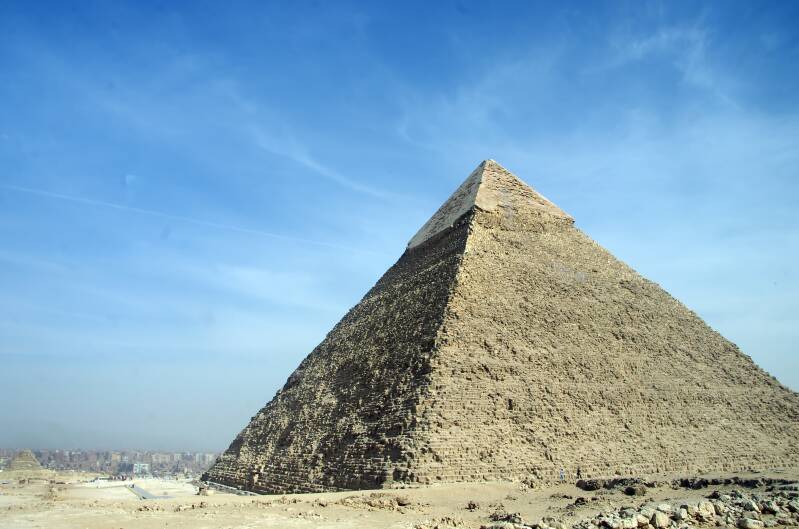

.jpg)
Nathan Hughes Hamilton from Sacramento, California, USA, CC BY 2.0
The Shape That Defies Gravity
Let's start with the most obvious reason, the one that doesn't require a PhD in archaeology to understand: Physics.
If you try to build a tall tower out of loose bricks or mud blocks, and you make the sides perfectly vertical, what happens? Gravity pulls the top down, and the weight of the upper layers crushes the bottom. The structure collapses. This is a problem every ancient builder faced, whether they were in the Nile Valley or the Yucatán Peninsula.
The pyramid is the solution. By sloping the sides inward, the weight of the structure is distributed down to the wide base. The wider the base, the more stable the tower. It is the most efficient way to build something tall and heavy using the materials available at the time—stone, mud brick, or packed earth.
According to the Smithsonian Institution (Smithsonian), "The pyramid shape is the most stable structure for a massive building because it distributes weight evenly to the base" [https://www.si.edu/spotlight/ancient-egypt/pyramid].
Think of it like a stack of books. If you stack them straight up, they wobble. If you arrange them in a staircase pattern, getting smaller as you go up, the stack becomes incredibly solid. Ancient builders didn't need calculus to figure this out; they just needed observation. They saw that mountains are shaped like pyramids, and mountains don't fall down. So, they copied nature.
This is the first thread in our hidden pattern: Convergent Evolution in Architecture. Just as birds and bats both evolved wings to fly (even though they aren't related), human cultures evolved pyramids to build high. It wasn't because they talked to each other; it was because the laws of physics are the same everywhere.
More Than Just Stones: The Spiritual Angle
But wait, if it was just about stability, why not just build a big, flat platform? Why point it at the sky?
Here is where the human spirit comes in. Across the globe, ancient civilizations shared a profound desire to connect the earthly realm with the divine. The pyramid, with its peak touching the heavens, became the ultimate bridge.
In Egypt, the pyramid was a ramp for the Pharaoh's soul to ascend to the stars. According to Penn State researchers probing the construction methods, "The pyramid was designed as a resurrection machine, a place where the king could transform and join the gods" [https://www.psu.edu/news/research/story/probing-question-how-were-egyptian-pyramids-built]. The shape itself was symbolic of the primordial mound that rose from the waters of chaos at the beginning of creation.
Now, let's jump to Central America. The Maya and Aztec civilizations built massive stepped pyramids, like the famous Chichén Itzá. While they weren't tombs in the same way Egyptian pyramids were, they served a similar spiritual purpose. They were temples where priests performed rituals to communicate with the gods of rain, sun, and maize.
According to the anthropological perspective discussed by The Archaeologist, "Pyramids served as artificial mountains, creating a sacred space closer to the heavens for religious ceremonies" [https://www.thearchaeologist.org/blog/why-did-all-civilizations-build-pyramid-shaped-large-scale-buildings-the-anthropological-perspective].
Notice the pattern? Whether it was the Pharaohs of Egypt or the Priests of the Maya, the pyramid was a vertical axis. It was a way to say, "We are down here, but we want to reach up there." It is a universal human longing to transcend our limitations.

Cvmontuy, CC BY-SA 3.0 <https://creativecommons.org/licenses/by-sa/3.0>, via Wikimedia Commons
The Mathematics of Mystery: Pi and the Pyramids
As we explore this pattern, we stumble upon something that makes modern mathematicians scratch their heads. There is a persistent theory that the Great Pyramid of Giza encodes the number Pi (π) and the Golden Ratio in its dimensions.
Pi is the ratio of a circle's circumference to its diameter (approximately 3.14159...). It's a fundamental constant of the universe. Some researchers have noted that if you take the perimeter of the Great Pyramid and divide it by twice its height, you get a number incredibly close to Pi.
According to a mathematical analysis from the University of Washington, "The dimensions of the Great Pyramid approximate the value of Pi with remarkable precision, suggesting a sophisticated understanding of geometry" [https://sites.math.washington.edu/~greenber/PiPyr.html].
Does this mean the ancient Egyptians knew about Pi? Or was it a happy accident?
Mathnasium, an educational organization, suggests that while the Egyptians may not have had the abstract concept of Pi as we do today, they certainly understood practical geometry. "Ancient builders used simple tools and ropes to create precise angles, and the pyramid shape naturally incorporates geometric ratios" [https://www.mathnasium.com/math-centers/northbethesda/news/geometry-pyramids-cleopatra-uncovering-secrets-ancient-egypt-nb].
Whether it was intentional or not, the fact that a structure built 4,500 years ago aligns so closely with a universal mathematical constant adds another layer to our hidden thread. It suggests that the universe has a mathematical order, and humans, across different times and places, have been trying to decode it.
The Global Tour: A Gallery of Pyramids
Let's take a quick tour around the world to see how this pattern plays out in different cultures. It's important to remember that these structures were built independently, often thousands of years apart.
| Location | Civilization | Primary Purpose | Unique Feature |
|---|---|---|---|
| Egypt | Old Kingdom | Royal Tombs | Smooth-sided, pointed apex |
| Mexico | Maya/Aztec | Temples | Stepped sides, flat tops for rituals |
| China | Han Dynasty | Imperial Tombs | Earth mounds with square bases |
| Peru | Moche/Norte Chico | Ceremonial Centers | Adobe bricks, often part of larger complexes |
| Indonesia | Borobudur (Stupa) | Buddhist Monument | Though a stupa, shares the tiered, mountain-like form |
According to Smithsonian Magazine, "Pyramids appear in almost every major ancient civilization, from the Nile to the Amazon, proving that this architectural form is a universal human response to the need for monumental structures" [https://www.smithsonianmag.com/history/ancient-pyramids-around-the-world-10343335/].
Even in China, the emperors were buried under massive pyramid-shaped mounds. These weren't made of stone blocks like in Egypt, but of packed earth and rammed soil, yet the shape remained the same. Why? Because the shape represented power and stability. A square base with four triangular faces is the most imposing shape you can build. It commands attention.
History Skills notes that "The presence of pyramids in diverse cultures highlights a shared human desire to create lasting monuments that reflect social hierarchy and cosmic order" [https://www.historyskills.com/classroom/year-7/world-pyramids/?srsltid=AfmBOopBpdgvoqKB2t3tjgIuYrCi-l5VsF7s9fs0AgspDt3OzPoDPpDo].
The Theory of Lost Connections: Did They Talk?
Okay, I have to address the elephant in the room. If the pyramids are so similar, didn't someone travel between these places?
There is a theory, often popularized in documentaries and fringe history, that a single "mother culture" or advanced civilization visited Earth and taught everyone how to build. Some historians have proposed that there might have been early maritime contacts that spread the idea.
According to a theory discussed in History News Network, "Some scholars argue that the similarities in pyramid construction suggest a diffusion of ideas through ancient trade routes or migration, rather than independent invention" [https://www.historynewsnetwork.org/article/a-theory-about-pyramids-that-could-change-the-way-].
However, the weight of archaeological evidence leans heavily toward independent invention. The construction techniques are vastly different. Egyptian pyramids were built with massive limestone blocks, transported by sledges and water. Mayan pyramids were built with limestone rubble and stucco, often using a different mortar. Chinese pyramids were earthworks.
The "Hidden Thread" here isn't a literal thread connecting the builders; it's a thread of human cognition. We are all wired to solve problems in similar ways. When you have a limited set of tools and a desire to build high, the pyramid is the logical conclusion. It's like how different cultures invented the wheel, the bow and arrow, and agriculture. We didn't need to meet to invent these things; we just needed to face the same challenges.

The Human Element: Who Actually Built Them?
One of the biggest myths about pyramids is that they were built by slaves. The image of whipped workers dragging stones is a Hollywood staple, but history tells a different story.
In Egypt, recent excavations have revealed worker villages near the pyramids. These weren't slave quarters; they were bustling towns where skilled laborers lived. They were fed well, given medical care, and paid in bread and beer. They took pride in their work.
According to Penn State, "Archaeological evidence shows that the pyramid builders were skilled laborers who worked in rotating shifts and were well-fed and cared for by the state" [https://www.psu.edu/news/research/story/probing-question-how-were-egyptian-pyramids-built].
This changes the narrative entirely. The pyramids weren't monuments to tyranny; they were monuments to community effort. They were the result of a society coming together to achieve something greater than any individual. This is a pattern we see in many great human achievements: the cathedrals of Europe, the Great Wall of China, and yes, the pyramids of the world. They are testaments to what we can do when we unite for a common goal.
Whimsical Reflection: The Skyward Gaze
As I sit here thinking about these ancient giants, I can't help but feel a sense of kinship with the people who built them. Imagine a farmer in ancient Egypt, looking up at the stars, wondering if his name will be remembered. Imagine a mason in Teotihuacán, chipping away at a stone, knowing he is building something that will outlast his grandchildren.
They were looking up. We are looking up.
The pyramid is a physical manifestation of a dream. It is the human desire to leave a mark, to say "I was here," to reach for something beyond the mundane. In a way, every time we build a skyscraper, launch a rocket, or even write a book, we are building a small pyramid. We are trying to touch the sky.
The hidden thread that connects the pyramids of Egypt, Mexico, and China isn't a secret society or alien technology. It is the shared heartbeat of humanity. It is the realization that no matter where we are born, no matter what language we speak, we all look at the horizon and wonder, "What's over there?" and "How high can we go?"
Become a Pattern Detective
So, what can we do with this knowledge?
- Visit a Local Museum:Many museums have replicas or artifacts from these ancient cultures. Look at the shapes. See if you can spot the pyramid influence in other architecture around you.
- Build Something:Try building a small pyramid out of sugar cubes or books. Feel the stability. Understand the physics with your own hands.
- Ask "Why?":When you see a pattern in your own life—maybe a habit you repeat, or a trend in your community—ask yourself: Is this a coincidence, or is there a deeper reason? Like the pyramids, many patterns in life are solutions to universal problems.
- Share the Wonder:Tell a friend about the global pyramid pattern. Curiosity is contagious!
Join the Adventure!
Did you enjoy this journey through time and stone? There are so many more hidden threads waiting to be pulled. From the spirals of galaxies to the patterns in bird migrations, the world is full of connections we haven't noticed yet.
If you want to stay updated on our latest discoveries, subscribe to The Hidden Thread newsletter. We send out a weekly digest of fascinating patterns, book recommendations, and behind-the-scenes looks at how we research our stories. No spam, just wonder.
Dive deeper: Where To Go Next
If you want to dive deeper into the world of ancient pyramids and the mysteries of human history, here are some excellent resources:
- The Smithsonian's Guide to Ancient Egypt:A comprehensive look at the history and construction of the pyramids. https://www.si.edu/spotlight/ancient-egypt/pyramid
- Penn State Research on Construction:Detailed analysis of how the pyramids were actually built and who built them. https://www.psu.edu/news/research/story/probing-question-how-were-egyptian-pyramids-built
- Anthropological Perspectives:An article exploring why different cultures built pyramids independently. https://www.thearchaeologist.org/blog/why-did-all-civilizations-build-pyramid-shaped-large-scale-buildings-the-anthropological-perspective
- Smithsonian Magazine:A visual journey through pyramids around the world. https://www.smithsonianmag.com/history/ancient-pyramids-around-the-world-10343335/
- Mathematical Mysteries:Exploring the geometry and Pi connections in the Great Pyramid. https://sites.math.washington.edu/~greenber/PiPyr.html
- History Skills:Educational resources on world pyramids for students and enthusiasts. https://www.historyskills.com/classroom/year-7/world-pyramids/
Book Tip: Further Reading
For a truly captivating look at the human drive to build, I recommend "Sapiens: A Brief History of Humankind" by Yuval Noah Harari. While not exclusively about pyramids, it beautifully explains how shared myths and cooperation allowed humans to build the impossible. It's available on Amazon and is a fantastic read for anyone interested in the patterns of human society.
Sources Used:
According to Penn State Research (Penn State), "The pyramid was designed as a resurrection machine, a place where the king could transform and join the gods" [https://www.psu.edu/news/research/story/probing-question-how-were-egyptian-pyramids-built]
According to the Smithsonian Institution (Smithsonian), "The pyramid shape is the most stable structure for a massive building because it distributes weight evenly to the base" [https://www.si.edu/spotlight/ancient-egypt/pyramid]
According to The Archaeologist (The Archaeologist), "Pyramids served as artificial mountains, creating a sacred space closer to the heavens for religious ceremonies" [https://www.thearchaeologist.org/blog/why-did-all-civilizations-build-pyramid-shaped-large-scale-buildings-the-anthropological-perspective]
According to Smithsonian Magazine (Smithsonian Magazine), "Pyramids appear in almost every major ancient civilization, from the Nile to the Amazon, proving that this architectural form is a universal human response to the need for monumental structures" [https://www.smithsonianmag.com/history/ancient-pyramids-around-the-world-10343335/]
According to History News Network (History News Network), "Some scholars argue that the similarities in pyramid construction suggest a diffusion of ideas through ancient trade routes or migration, rather than independent invention" [https://www.historynewsnetwork.org/article/a-theory-about-pyramids-that-could-change-the-way-]
According to History Skills (History Skills), "The presence of pyramids in diverse cultures highlights a shared human desire to create lasting monuments that reflect social hierarchy and cosmic order" [https://www.historyskills.com/classroom/year-7/world-pyramids/]
According to the University of Washington (University of Washington), "The dimensions of the Great Pyramid approximate the value of Pi with remarkable precision, suggesting a sophisticated understanding of geometry" [https://sites.math.washington.edu/~greenber/PiPyr.html]
According to Mathnasium (Mathnasium), "Ancient builders used simple tools and ropes to create precise angles, and the pyramid shape naturally incorporates geometric ratios" [https://www.mathnasium.com/math-centers/northbethesda/news/geometry-pyramids-cleopatra-uncovering-secrets-ancient-egypt-nb]
Add comment
Comments