

Have you ever stopped to really look at a dandelion? Not just the bright yellow flower, but the way its petals seem to swirl out from the center like a tiny, green galaxy. Or perhaps you’ve noticed the tight, perfect spiral of a pinecone sitting on your driveway, or the way sunflower seeds pack themselves into a mesmerizing pattern that looks almost too organized to be random.
It’s easy to walk past these things, thinking they’re just "how plants grow." But if you take a ruler to them—or even just count the spirals—you’ll find something strange. They aren’t just growing in circles. They are following a mathematical rule that was discovered centuries ago, yet it feels like it was written into the DNA of the universe itself.
Welcome to the world of the Fibonacci sequence. It’s a number pattern that shows up everywhere from the grandest galaxies to the humblest garden weed. And today, we’re going to pull back the curtain on why nature seems obsessed with this specific set of numbers.
What Exactly Is This "Fibonacci" Thing?
Before we dive into the garden, let’s clear up the math without getting bogged down in a textbook. The Fibonacci sequence is a list of numbers where each number is the sum of the two numbers before it. It starts like this:
0, 1, 1, 2, 3, 5, 8, 13, 21, 34, 55, 89...
See the pattern?
- 0 + 1 = 1
- 1 + 1 = 2
- 1 + 2 = 3
- 2 + 3 = 5
- 3 + 5 = 8
- And so on...
It sounds simple, right? But here is the kicker: as the numbers get bigger, the ratio between them gets closer and closer to a very special number called the "Golden Ratio" (often represented by the Greek letter Phi, or φ). This ratio, roughly 1.618, is considered the most aesthetically pleasing proportion in art and architecture. But nature didn’t learn about art galleries; it learned about efficiency.
According to the Cornell University Museum of Vertebrates, "Nature and Math: The Fibonacci Sequence," this sequence isn't just a human invention; it is a fundamental blueprint for growth in the natural world [https://museum.cornell.edu/nature-and-math-the-fibonacci-sequence/].
The Great Garden Count-Off
Let’s go outside. Grab a magnifying glass if you have one, and let’s look at what’s hiding in your backyard.
The Sunflower’s Secret Code
Walk up to a sunflower. Look at the center disk. You’ll see two sets of spirals: one curving clockwise and one curving counter-clockwise. If you count them, you won’t find just any numbers. You’ll almost always find Fibonacci numbers.
According to Discover Magazine, in their article "Are These 10 Natural Occurrences Examples of the Fibonacci Sequence?", researchers have found that sunflowers typically have 34 spirals in one direction and 55 in the other, or sometimes 55 and 89 [https://www.discovermagazine.com/are-these-10-natural-occurrences-examples-of-the-fibonacci-sequence-46574]. These are consecutive numbers in the Fibonacci sequence!
Why? Because this arrangement allows the plant to pack the maximum number of seeds into the smallest space. If the seeds were arranged in straight lines or random clusters, there would be gaps, and fewer seeds could fit. The spiral ensures every seed has room to grow without bumping into its neighbor too early.
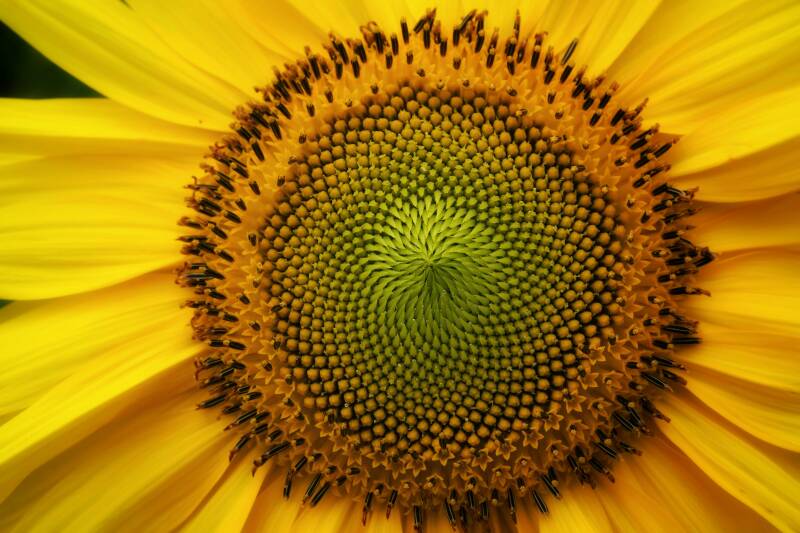
Photo by Brandon Thorp: https://www.pexels.com/photo/close-up-shot-of-a-sunflower-13438108/
Pinecones and Pineapples
Pick up a pinecone. Trace the spirals going up the scales. You’ll likely find 8 spirals going one way and 13 going the other. Again, 8 and 13 are Fibonacci numbers.
The BBC Bitesize guide on the topic explains that this pattern is visible in many plants, including pineapples, where you can count 8 spirals in one direction and 13 in the other [https://www.bbc.co.uk/bitesize/articles/zm3rdnb]. It’s as if the plant has a built-in calculator that knows exactly how to stack its fruit for maximum stability and space.

Photo by Any Lane: https://www.pexels.com/photo/photo-of-ripe-pinapple-on-pink-background-5945885/
The Spiral of a Snail Shell
It’s not just plants. If you find a snail shell or a nautilus shell on a beach, you’ll see the same logarithmic spiral. As the animal grows, it adds new chambers to its shell in a way that maintains the same shape, expanding outward according to the Golden Ratio.
HowStuffWorks notes in "Fibonacci in Nature" that this spiral allows the creature to grow without changing its overall shape, providing a perfect, efficient housing that expands seamlessly as the animal gets bigger [https://science.howstuffworks.com/math-concepts/fibonacci-nature.htm].

Photo by konat umut budak: https://www.pexels.com/photo/a-snail-on-a-stick-with-a-brown-background-27174209/
Why Does Nature Love This Pattern So Much?
You might be wondering: Did the universe sit down with a pencil and decide, "Let’s make everything follow the Fibonacci sequence"? Or is there a practical reason?
The answer leans heavily toward practicality. In the wild, efficiency is survival.
The Sunlight Problem
Imagine you are a leaf growing on a stem. If your leaves grew directly on top of each other, the bottom ones would never see the sun. They would die, and the plant would starve.
Nature solved this by arranging leaves in a spiral pattern around the stem. The angle between each new leaf is roughly 137.5 degrees. This is known as the "golden angle."
According to the American Museum of Natural History (AMNH), in their piece "The Secret of the Fibonacci Sequence in Trees," this specific angle ensures that no leaf blocks the sunlight from the one below it. It’s a perfect packing problem solved by evolution over millions of years [https://www.amnh.org/learn-teach/curriculum-collections/young-naturalist-awards/the-secret-of-the-fibonacci-sequence-in-trees].
Packing Seeds Efficiently
Back to the sunflower. The plant needs to produce as many seeds as possible to ensure its species survives. The Fibonacci spiral is the most efficient way to pack circular objects (like seeds) into a circle. Any other angle would result in "gaps" or "rays" where seeds are missing.
Research published on ResearchGate, titled "The Fibonacci Sequence: Nature's Little Secret," suggests that this mathematical efficiency is a result of physical constraints during growth. The cells divide and push against each other, naturally settling into the most stable, space-saving configuration, which happens to align with the Fibonacci sequence [https://www.researchgate.net/publication/275994357_The_Fibonacci_Sequence_Nature's_Little_Secret].
A Universal Language
It turns out that this isn’t just a quirk of Earth. While we can’t easily check the flowers on Mars yet, the physics of growth and packing are universal. Whether it’s the branching of trees, the veins in a leaf, or the arrangement of petals, the rules of geometry and physics apply everywhere.
As noted in an EBSCO blog post, "Nature's Mathterpiece: Fibonacci Sequence," this pattern appears in everything from the branching of rivers to the formation of hurricanes, suggesting that the Fibonacci sequence is a fundamental principle of how energy and matter organize themselves [https://about.ebsco.com/blogs/ebscopost/natures-mathterpiece-fibonacci-sequence].
A Table of Nature’s Favorites
To make it easier to spot these patterns yourself, here is a quick cheat sheet of what to look for in your garden or on a hike:
| Plant/Thing | Where to look | Typical Fibonacci Numbers Found |
|---|---|---|
| Sunflower | Seed head spirals | 34 & 55, or 55 & 89 |
| Pinecone | Scale spirals | 8 & 13 |
| Pineapple | Fruit scales | 8, 13, & 21 |
| Daisy | Petal count | 13, 21, or 34 |
| Broccoli | Floret spirals | 5, 8, 13 |
| Tree Branches | Branching patterns | Often follows the sequence |
| Succulents | Leaf rosettes | 3, 5, 8, 13 |
Data compiled from various botanical studies and observations.
The Whisper in the Leaves: A Whimsical Reflection
There is something deeply comforting about finding a pattern in the chaos. We live in a world that often feels random, noisy, and unpredictable. But then, you look at a fern unfurling in the spring, or a pinecone resting in your palm, and you realize there is a rhythm underneath it all.
It’s as if the universe is humming a song, and the Fibonacci sequence is the melody. It’s a reminder that even in the wildest, most untamed corners of nature, there is order. There is a logic that connects the smallest seed to the tallest tree.
Maybe the reason we find these patterns so beautiful is that they speak to a part of us that craves connection. We are made of the same stuff as the stars and the soil. We, too, grow in spirals. Our DNA coils in a double helix, a structure that echoes the spirals of the shells and the sunflowers. We are not separate from this math; we are part of the equation.
What Can You Do With This Knowledge?
You don’t need a degree in botany or a PhD in mathematics to appreciate the hidden thread. Here are a few ways to bring this wonder into your life:
- Go on a "Fibonacci Hunt":Grab a notebook and head to your local park or garden. Try to count the petals on a flower or the spirals on a pinecone. See if you can find the numbers 3, 5, 8, 13, or 21.
- Photograph the Spirals:Take pictures of the patterns you find. Notice how the light hits the curves. Share them with friends and challenge them to guess the number.
- Plant with Purpose:If you have a garden, try planting flowers in spiral patterns. It’s not just for looks; it helps with airflow and sunlight for your plants, too.
- Teach the Kids:Show children how to count the spirals. It’s a fantastic way to introduce math in a way that feels like magic rather than homework.
As the UC Master Gardeners of San Mateo and San Francisco Counties suggest in their article "Wonder of Fibonacci in Our Gardens," observing these patterns can deepen our connection to the plants we grow and the ecosystems we share [https://ucanr.edu/blog/uc-master-gardeners-san-mateo-san-francisco-counties/article/wonder-fibonacci-our-gardens].
Join The Hidden Thread
Did you enjoy this journey into the math of nature? There is so much more to uncover in the hidden patterns of our world. From the symmetry of snowflakes to the rhythm of tides, the universe is full of secrets waiting to be counted.
If you want to stay updated on our latest discoveries, subscribe to The Hidden Thread newsletter. We send out one email a week with a new pattern to look for, a book recommendation, and a little bit of whimsy to brighten your day. No spam, just wonder.

Book tip:
If you want to take this fascination home with you, I highly recommend "The Golden Ratio: The Story of Phi, the World's Most Astonishing Number" by Mario Livio.
Available on Amazon, this book explores the history of the Golden Ratio and the Fibonacci sequence, tracing their influence from ancient Greece to modern art and science. It’s written in a way that is engaging for anyone, regardless of their math background, and it perfectly captures the sense of wonder that comes with discovering these patterns.
Sources Used and Further reading
According to the Cornell University Museum of Vertebrates, "Nature and Math: The Fibonacci Sequence" [https://museum.cornell.edu/nature-and-math-the-fibonacci-sequence/]
According to Discover Magazine, "Are These 10 Natural Occurrences Examples of the Fibonacci Sequence?" [https://www.discovermagazine.com/are-these-10-natural-occurrences-examples-of-the-fibonacci-sequence-46574]
According to the BBC, "The Fibonacci Sequence" [https://www.bbc.co.uk/bitesize/articles/zm3rdnb]
According to the American Museum of Natural History, "The Secret of the Fibonacci Sequence in Trees" [https://www.amnh.org/learn-teach/curriculum-collections/young-naturalist-awards/the-secret-of-the-fibonacci-sequence-in-trees]
According to EBSCO, "Nature's Mathterpiece: Fibonacci Sequence" [https://about.ebsco.com/blogs/ebscopost/natures-mathterpiece-fibonacci-sequence]
According to ResearchGate, "The Fibonacci Sequence: Nature's Little Secret" [https://www.researchgate.net/publication/275994357_The_Fibonacci_Sequence_Nature's_Little_Secret]
According to HowStuffWorks, "Fibonacci in Nature" [https://science.howstuffworks.com/math-concepts/fibonacci-nature.htm]
According to the UC Master Gardeners of San Mateo and San Francisco Counties, "Wonder of Fibonacci in Our Gardens" [https://ucanr.edu/blog/uc-master-gardeners-san-mateo-san-francisco-counties/article/wonder-fibonacci-our-gardens]
Related posts
- Coming soon!
Add comment
Comments